
XIAMEN ACEY NEW ENERGY TECHNOLOGY CO., LTD.

Categorie
Nuovo blog
Come assemblare un pacco batteria cilindrico: guida al processo e alle attrezzature
August 28 , 2026Come assemblare un pacco batterie cilindrico: procedura e attrezzatura necessarie
I pacchi batteria cilindrici utilizzati in utensili elettrici, biciclette elettriche, droni, centrali elettriche portatili e sistemi di accumulo di energia possono differire notevolmente per tensione, capacità e struttura, ma la maggior parte delle linee di produzione segue una sequenza di assemblaggio simile.
Le fasi principali includono la classificazione della capacità delle celle, l'applicazione della carta isolante, la selezione della tensione a circuito aperto (OCV) e della resistenza interna, la disposizione delle celle, l'ispezione della polarità, la saldatura a punti e il test del BMS.Einstallazione, test del pacco finito, confezionamento, codifica e invecchiamento di carica-scarica.
Questi processi possono essere organizzati come postazioni di lavoro offline, una linea semiautomatica o una linea di produzione completamente automatizzata.
Processo di assemblaggio del pacco batterie cilindrico
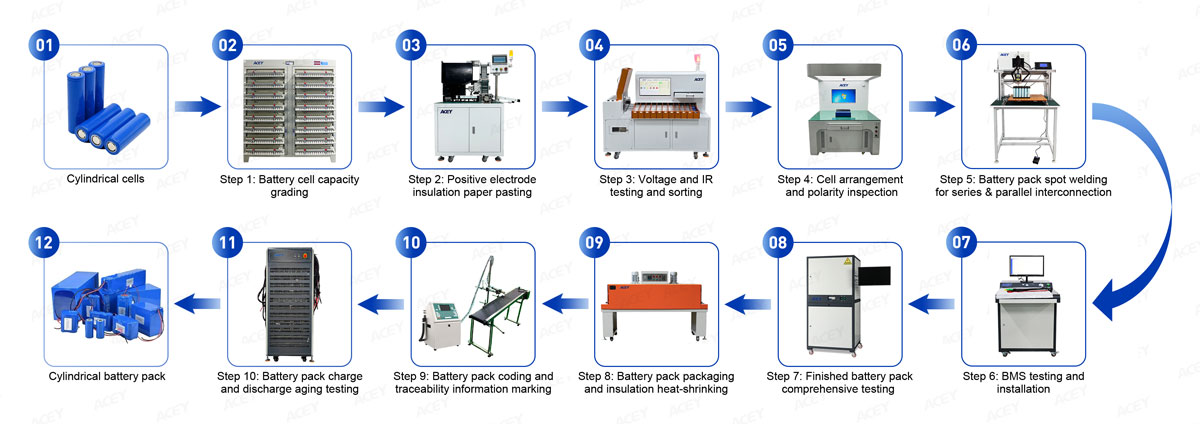
Classificazione della capacità delle celle → Incollaggio della carta isolante → Selezione OCV e ACIR → Disposizione delle celle → Ispezione della polarità → Saldatura a punti → Test e installazione del BMS → Test del pacco batteria → Imballaggio e codifica → Invecchiamento di carica/scarica
Le prime fasi si concentrano sulla consistenza delle celle e sul corretto allineamento. La saldatura e l'assemblaggio del BMS (Battery Management System) stabiliscono la connessione elettrica del pacco, mentre i test e l'invecchiamento del pacco finito servono a verificarne la funzionalità prima della spedizione.
Componenti principali di un pacco batterie cilindrico
Un pacco batterie cilindrico è composto principalmente da:
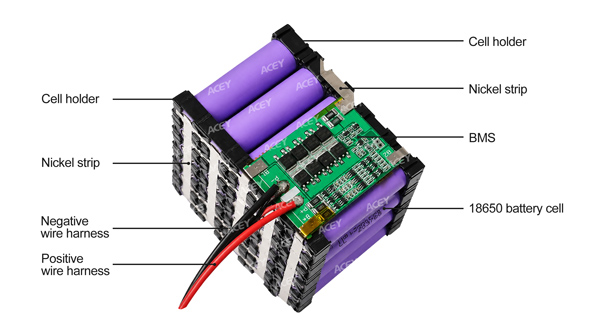
Il collegamento in serie determina la tensione del pacco batterie, mentre il collegamento in parallelo aumenta la capacità e la corrente erogabile.
Dimensioni e applicazioni comuni delle celle cilindriche
Formati cellulari supportati
14500 · 18650 · 21700 · 26650 · 32650 · 32700 · 32140 · 33140
Non tutte le macchine utilizzano gli stessi utensili. Potrebbe essere necessario sostituire dispositivi di fissaggio, porta-celle e meccanismi di alimentazione quando cambiano il diametro, l'altezza o la struttura del pacco cellulare.
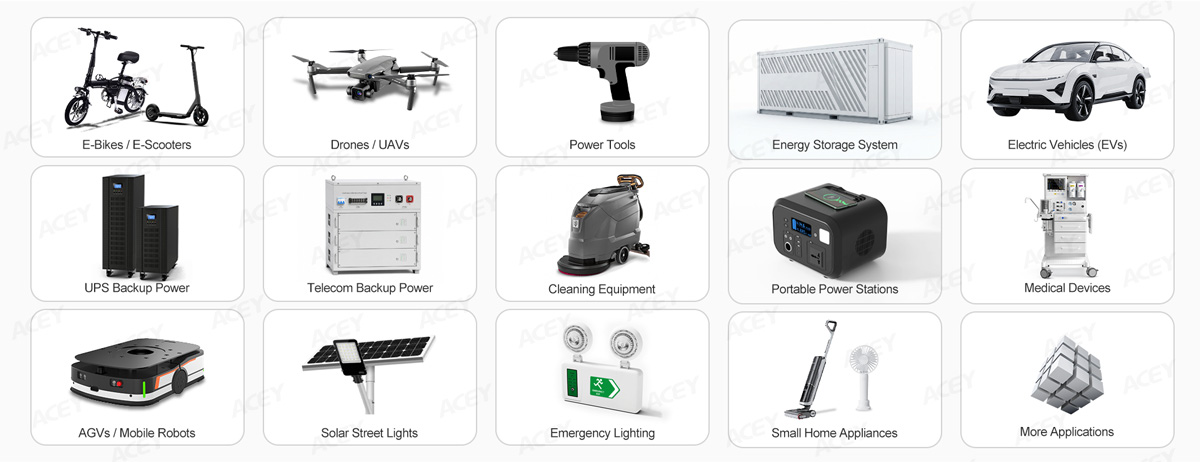
Applicazioni tipiche
Quali attrezzature vengono utilizzate per assemblare un pacco batterie cilindrico?
Un impianto di produzione completo può includere le seguenti apparecchiature:
| Processo | Scopo | Attrezzatura |
| Classificazione della capacità | Misurare e raggruppare le cellule in base alla capacità | Macchina per la classificazione delle celle di batteria |
| Isolamento | Applicare la carta isolante al terminale positivo | Macchina per incollare carta isolante |
| Smistamento OCV e ACIR | Raggruppa le celle in base a tensione e resistenza | Macchina per la selezione delle batterie |
| Ispezione della polarità | Controllo terminali positivo e negativo del pacco | Macchina per il test di polarità CCD |
| Collegamento elettrico | Saldare le strisce di collegamento alle celle | Pacco batterie per saldatrice a punti |
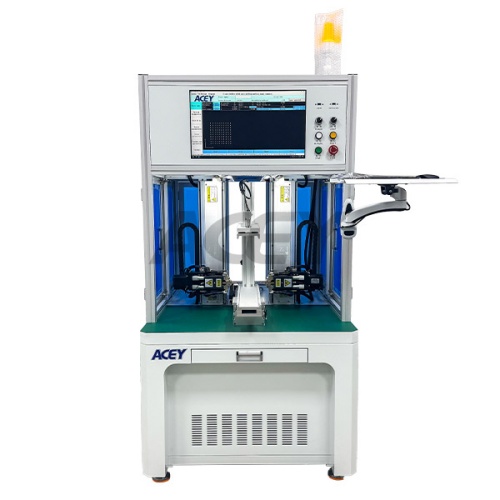
| Verifica BMS | Test delle funzioni della scheda di protezione | Tester BMS |
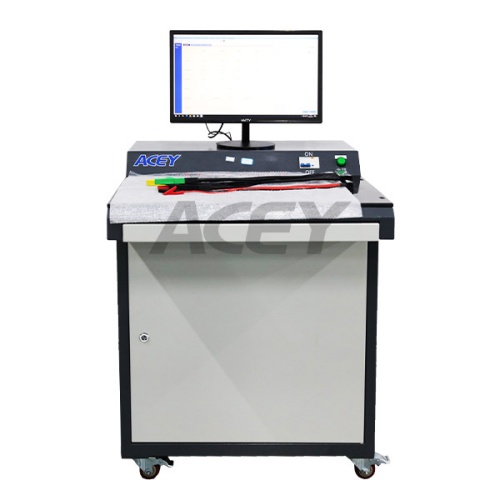
| Test del prodotto finito | Verificare le prestazioni del pacco assemblato | Tester completo per batterie |
| Confezione | Applicare la pellicola termoretraibile | Macchina termoretraibile |
| Identificazione | Stampa le informazioni relative al lotto e al prodotto | Macchina codificatrice |
| Invecchiamento | Eseguire cicli di carica e scarica | Tester di invecchiamento del pacco batteria |
Nella produzione di prototipi o piccole serie, diverse operazioni possono rimanere manuali. Le linee di produzione su larga scala automatizzano i processi che incidono maggiormente sulla uniformità e sulla produttività, in particolare la selezione, il controllo della polarità, la saldatura e il collaudo.
Fase 1 — Valutazione della capacità delle celle
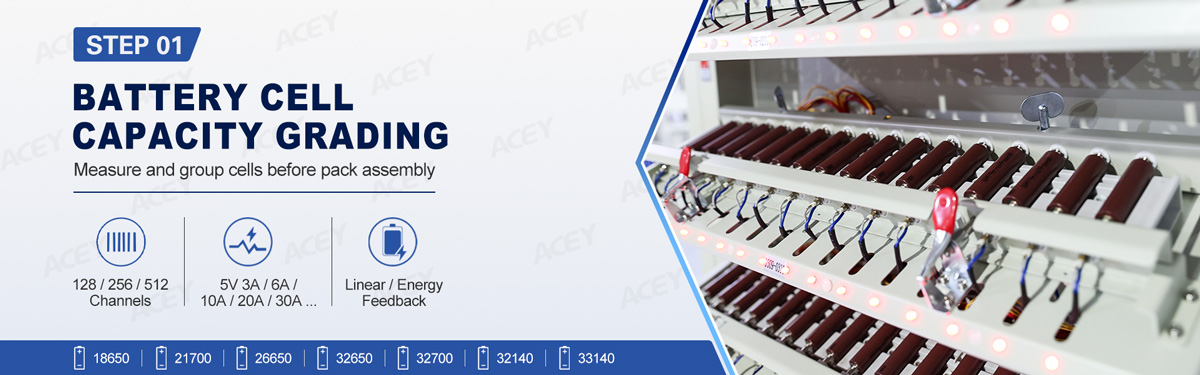
Prima dell'assemblaggio, le celle vengono caricate e scaricate per misurare la capacità utilizzabile e le prestazioni di base.
Lo scopo è impedire che celle con capacità molto diverse, dovute all'esaurimento o alla perdita di carica durante lo stoccaggio o il trasporto prolungati, vengano raggruppate nello stesso pacco batterie. Le celle meno performanti limitano le prestazioni utilizzabili dell'intero assemblaggio, sia in serie che in parallelo.
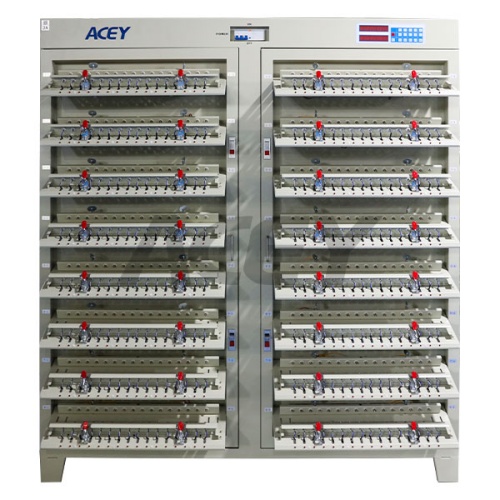
UN ltioione macchina per la classificazione cellulare Esegue cicli di carica-scarica programmati su più canali e registra i dati per ciascuna cella.
I sistemi di classificazione ACEY possono essere configurati per formati cilindrici comuni come:
18650 · 21700 · 26650 · 32650 · 32700 · 32140 · 33140
Le configurazioni disponibili includono:
Per la lavorazione di grandi volumi di cellule, la classificazione multicanale consente di testare centinaia di cellule contemporaneamente prima che entrino nella fase di assemblaggio del pacco.
Attrezzatura consigliata: Macchina per la classificazione delle celle della batteria
Fase 2 — Applicazione della carta isolante
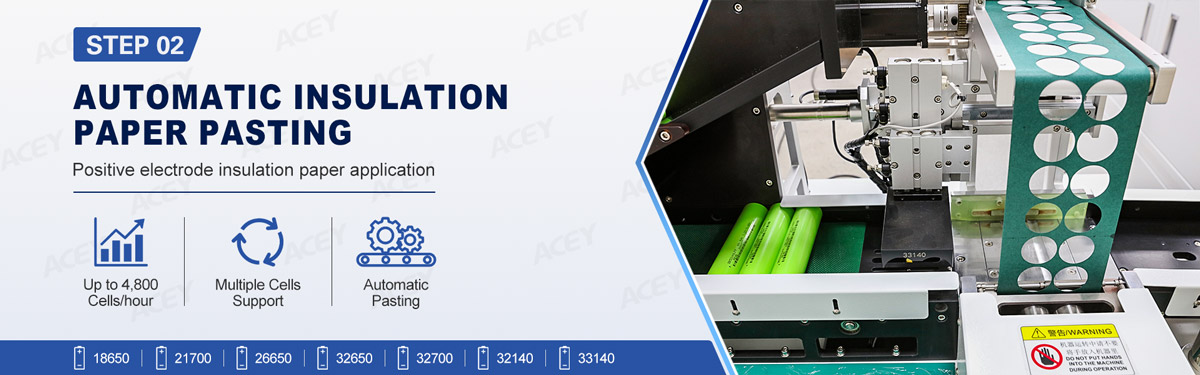
La carta isolante viene applicata attorno al terminale positivo dopo la classificazione della capacità.
Questo isolamento aggiuntivo contribuisce a separare la zona del terminale positivo dall'involucro metallico della cella (anodo) durante l'assemblaggio.
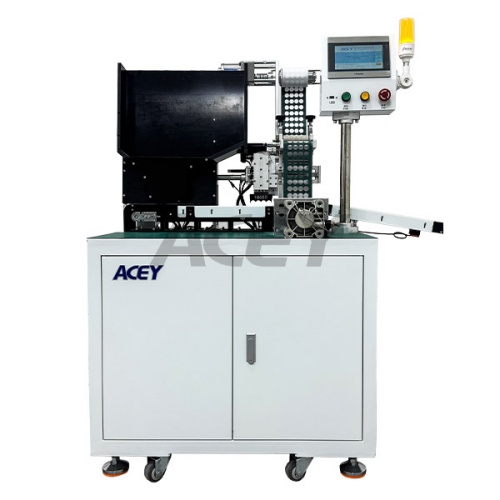
UNmacchina automatica per l'applicazione di carta isolanteTaglia e applica la carta con un posizionamento preciso. Le macchine ACEY possono essere equipaggiate con utensili intercambiabili per diverse celle cilindriche.
La velocità di produzione può raggiungere fino a 4.800 celle all'ora, a seconda della configurazione delle celle e della macchina.
I formati più comuni includono:
18650 · 21700 · 26650 · 32650 · 32700
Larger cylindrical cells such as 32140 and 33140 require suitable tooling and machine configuration.
Recommended Equipment: Battery Insulation Paper Sticking Machine
Step 3 — OCV and Internal Resistance Sorting
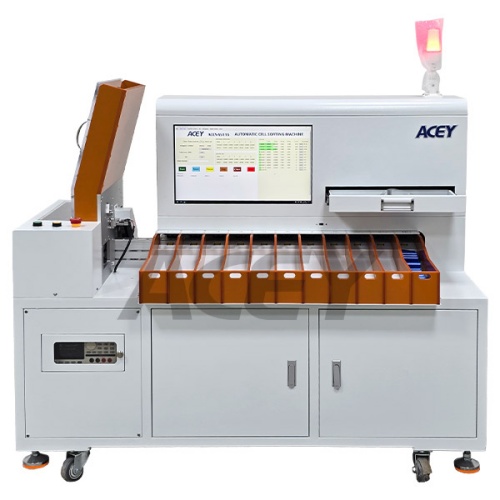
Capacity grading alone is not enough for final cell matching.
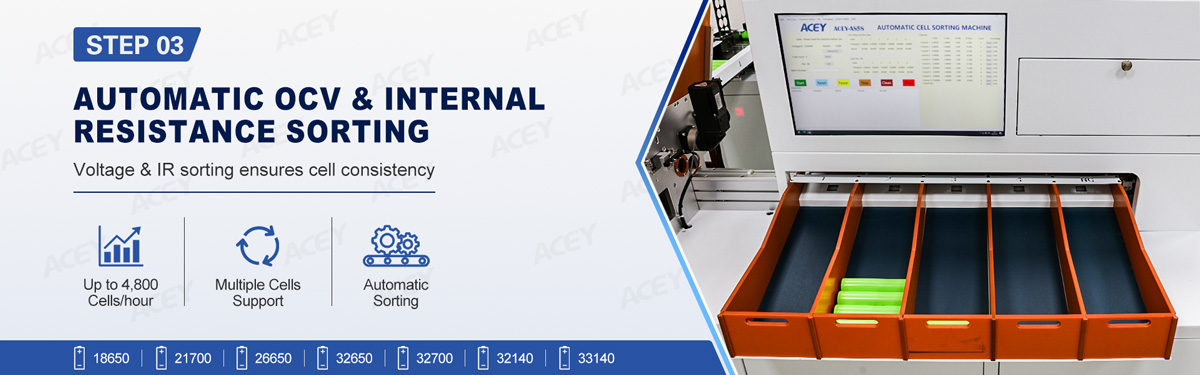
Before assembly, it is also necessary to measure theopen-circuit voltageandAC internal resistanceof the battery cells to ensure the consistency of the battery pack.
The measured values are compared with preset ranges, and the cells are automatically separated into different groups.
ACEY cylindrical battery sorting machines are available with standard 5-, 6-, 10-, or 11-channel configurations, with customized options also available. They can be integrated with branded testers such as the HIOKI BT3561 or other compatible instruments to measure open-circuit voltage (OCV) and AC internal resistance.
Barcode scanning can also be added when the production process requires cell-level traceability.
Cells with large differences in voltage or resistance may behave differently under charge and discharge. Sorting helps the manufacturer build packs from cells with closer electrical characteristics.
For production lines that combine insulation paper application and sorting, these processes can also be integrated to reduce repeated cell handling.
Recommended Equipment: Cylindrical Battery Sorting Machine
Step 4 — Cell Arrangement and Polarity Inspection
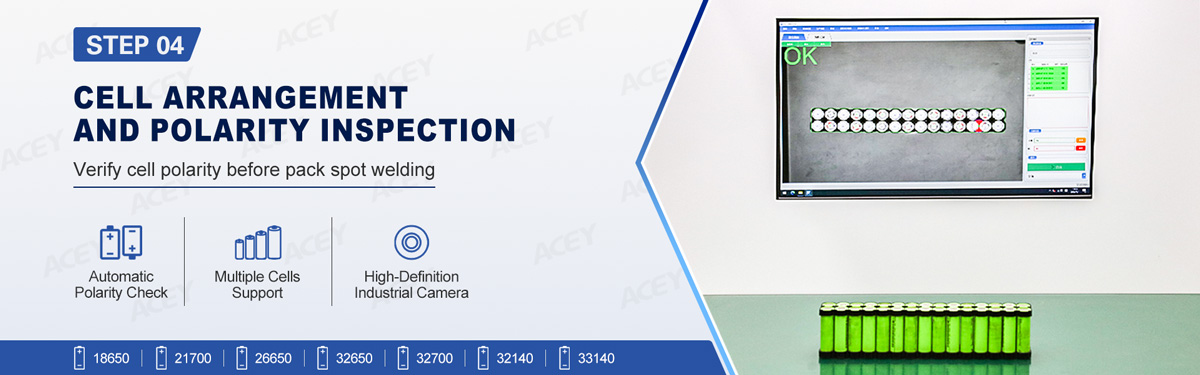
Sorted cells are placed into the required series-parallel arrangement using cell holders or dedicated fixtures.
Before welding, the positive and negative orientation of every cell should be checked.
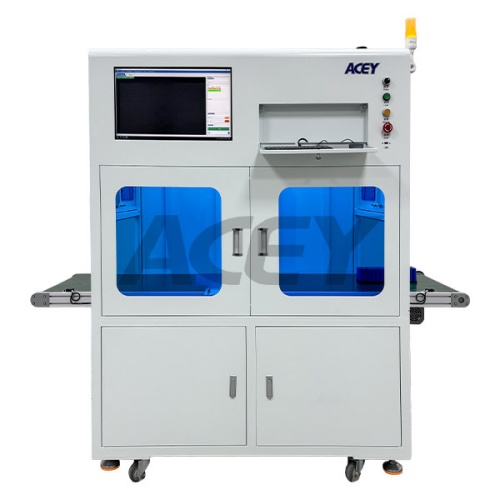
For small production runs, this may be done manually. On semi-automatic and automatic lines, a CCD polarity inspection system is more reliable because it checks the complete cell group against the preset pattern.
ACEY CCD inspection systems can be configured for cylindrical cells including:
18650 · 21700 · 26650 · 32650 · 32700 · 32140 · 33140
Any reversed or incorrectly positioned cell can be identified before the pack enters the welding station.
Recommended Equipment: CCD Tester
Step 5 — Battery Pack Spot Welding
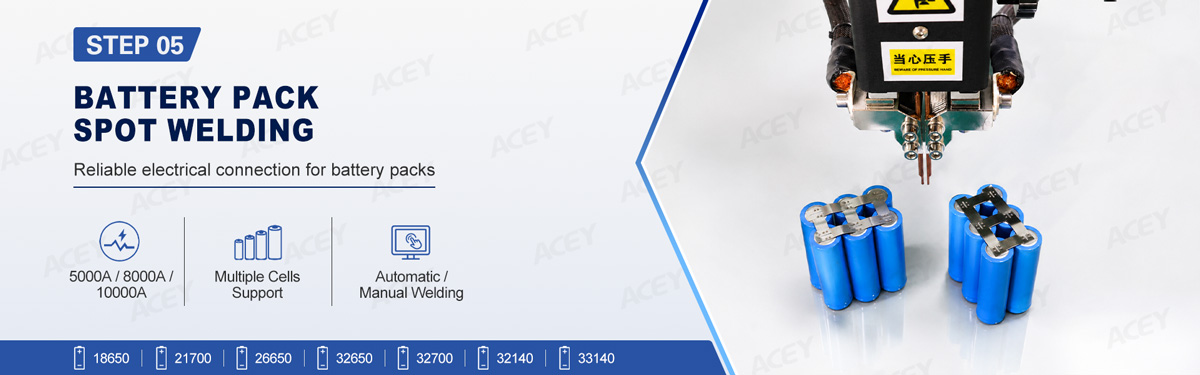
Spot welding is one of the most important operations in cylindrical battery pack assembly.
The cells are connected in series and parallel by welding nickel or nickel-plated connecting strips to the cell terminals.
The welding result is affected by more than welding current. The main process variables include:
ACEY provides 5000A, 8000A and 10000A DC inverter or transistor welding power supply configurations for cylindrical battery pack assembly.
Machine options include:
Automatic models can store welding programs for different battery pack designs and move between preset welding positions.
For production use, welding parameters should be validated with the actual cell and connecting strip. A parameter that works well on one battery pack should not automatically be copied to another design.
The inspection criteria may include weld appearance, connection strength and electrical resistance according to the manufacturer’s own process standard.
Recommended Equipment: Battery Pack Spot Welding Machine
Step 6 — BMS Testing and Installation
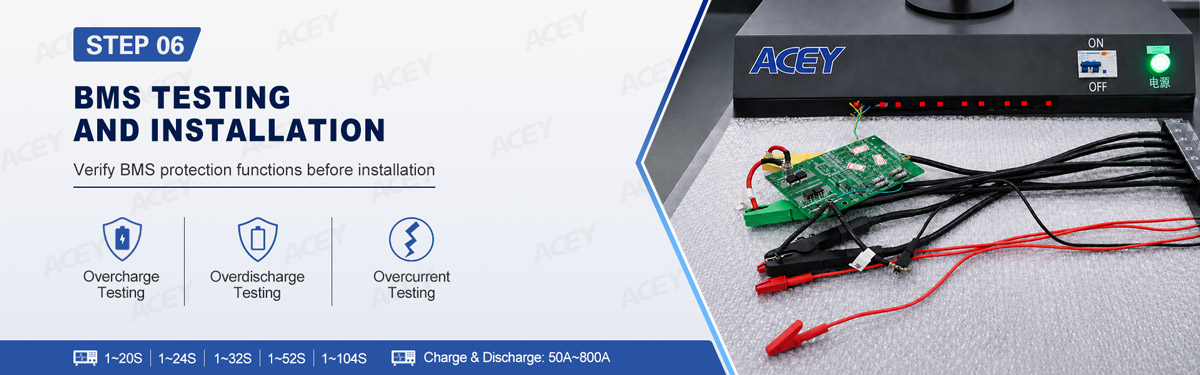
After the cell groups are electrically connected, the battery management system is installed according to the pack design.
Before installation or final integration, the BMS can be tested to verify its protection functions.
A BMS tester mainly check functions such as:
The required test range is determined by the BMS series count, voltage and current rating.
After BMS verification, assembly work includes:
This part of the process varies significantly from one battery pack to another. BMS specifications and electrical drawings are therefore important when configuring the assembly workstation or production line.
Recommended Equipment: BMS Tester
Step 7 — Finished Battery Pack Testing
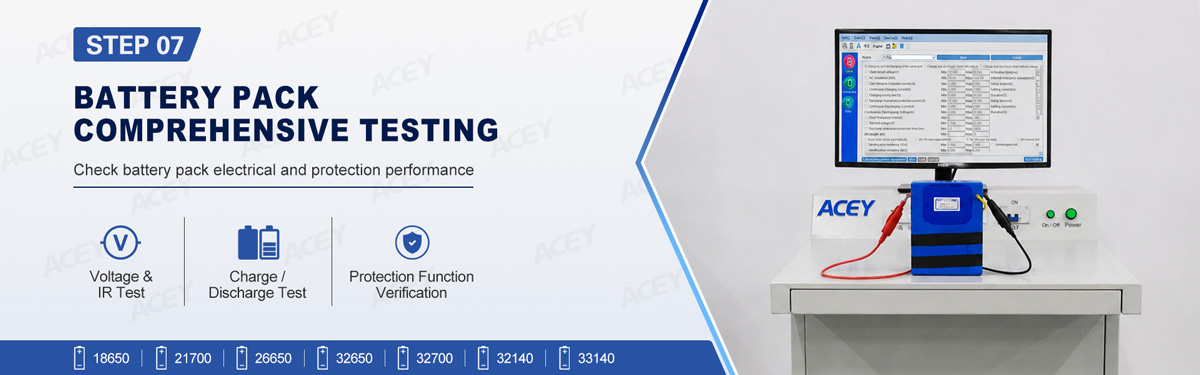
Once the BMS, wiring and electrical connections are complete, the battery pack is tested as a finished assembly.
This step checks components and connections introduced during battery pack assembly rather than the performance of an individual cell.
A battery comprehensive tester can be configured to test:
Upper and lower limits are set in the test program, allowing the equipment to identify qualified and unqualified packs.
Finished pack testing is particularly useful for detecting problems related to:
ACEY provides different voltage and current configurations for small and larger battery packs.
Recommended Equipment: Battery Comprehensive Tester
Step 8 — Battery Pack Packaging
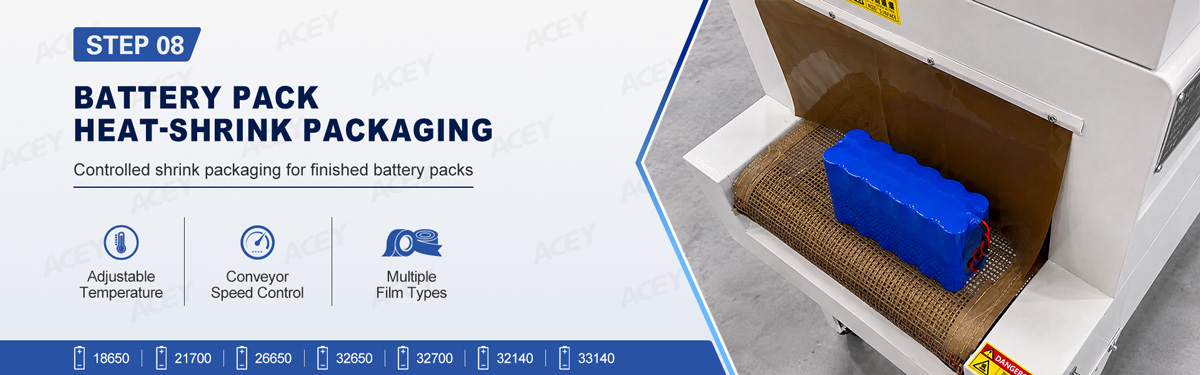
After electrical testing, the pack is prepared for final packaging.
The packaging method may include:
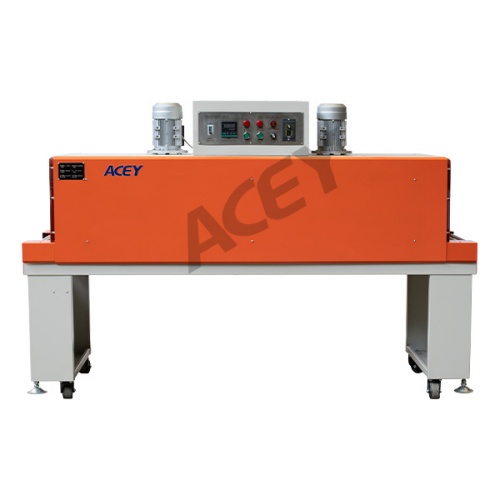
For heat-shrink packaging, the pack passes through a temperature-controlled shrink tunnel.
ACEY heat shrink machines are available with adjustable conveyor speed and temperature settings for different pack sizes and film materials.
Recommended Equipment: Automatic Heat Shrink Wrap Machine
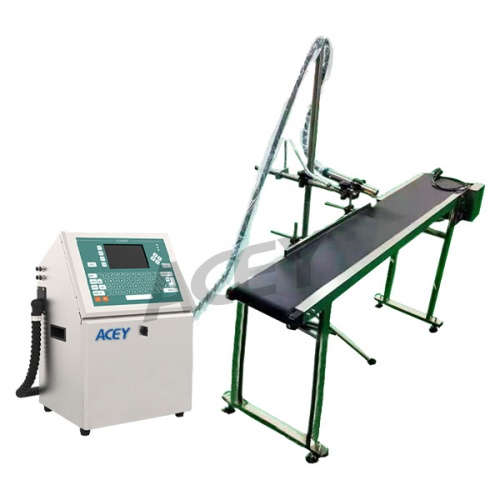
Step 9 — Coding and Traceability
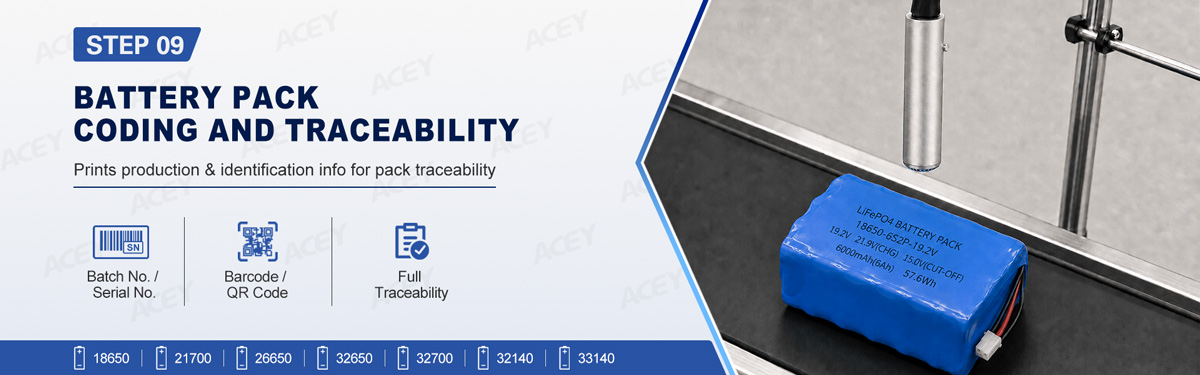
Pack identification is added before shipment or aging.
Printed information includes:
A handheld printer may be enough for small-batch production, while conveyor-based or continuous inkjet printers are more suitable for production lines.
If traceability is required, the printed code can be linked with earlier cell or pack test records.
Recommended Equipment: Battery Pack Coding Machine
Step 10 — Charge/Discharge Aging
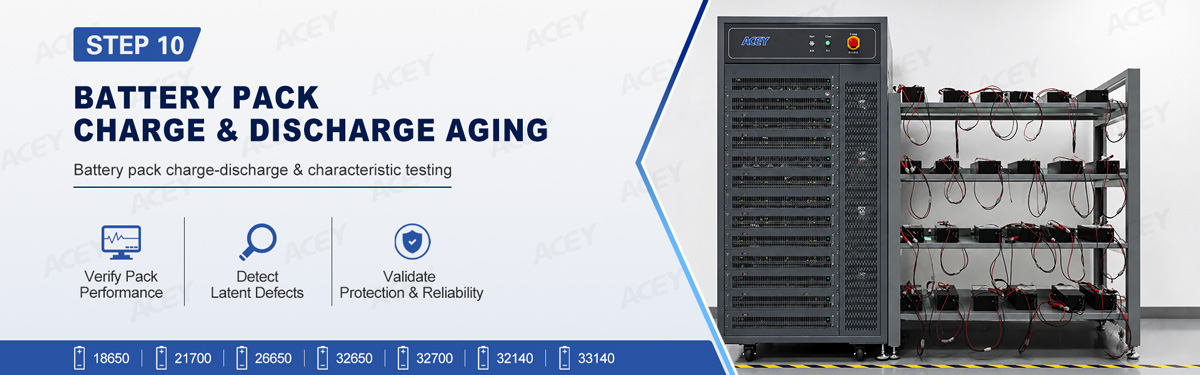
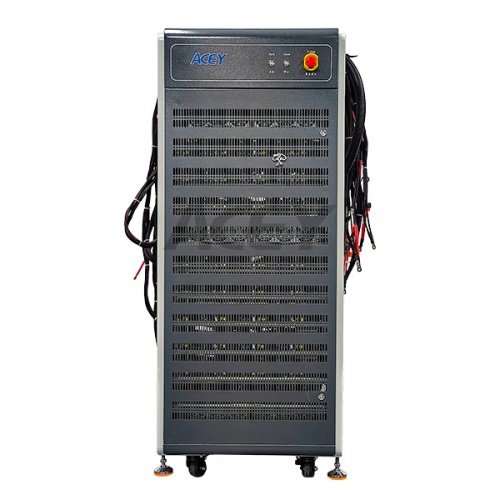
Aging is one of the final electrical verification steps.
The battery pack is charged and discharged according to a programmed test sequence. The system can record:
ACEY battery pack charge-discharge and aging systems cover a wide range of battery pack applications.
Available configurations include:
The selected tester must cover the pack’s maximum voltage and required charge/discharge current. Channel quantity is usually selected according to the planned production output and aging time.
For higher-power applications, energy-feedback systems can return part of the discharge energy to the electrical network instead of dissipating it only as heat.
Recommended Equipment: Battery Pack Aging Machine
Semi-Automatic or Fully Automatic?
The higher automation option is not always the better choice.
A semi-automatic production setup is more flexible when the manufacturer produces several battery pack models or changes fixtures frequently.
| Factor | Semi-Automatic Line | Fully Automatic Line |
| Production Volume | Small to medium | Medium to high |
| Investment | Lower | Higher |
| Changeover | More flexible | More dependent on tooling and line design |
| Labor | More manual operations | Lower labor requirement |
| Integration | Standalone or partially connected equipment | Integrated material flow |
| Traceability | Added where required | Easier to integrate across multiple processes |
Many cylindrical battery pack lines use a combination of both.
For example, cell sorting, CCD polarity inspection and automatic spot welding can be automated, while BMS installation, wiring or enclosure assembly remains manual.
This approach often gives better flexibility than trying to automate every process from the beginning.
How to Configure Cylindrical Battery Pack Assembly Equipment
The equipment should be selected from the actual battery pack design rather than only from the cell model.
Two 21700 battery packs may require completely different fixtures, welding machines and test systems if their series-parallel configuration, current requirement and mechanical structure are different.
Before equipment selection, it is useful to confirm the following information.
Cell Information
Battery Pack Design
Welding Information
BMS Information
Production Requirement
Testing Requirement
These details make it much easier to match each machine to the actual process and avoid buying equipment with either insufficient capacity or unnecessary specifications.
ACEY Cylindrical Battery Pack Assembly Solutions
ACEY supplies individual machines, semi-automatic production equipment and fully automatic assembly solutions for cylindrical lithium battery packs.
Equipment can be configured for cells including:
18650 · 21700 · 26650 · 32650 · 32700 · 32140 · 33140
Available processes cover:
For production-line projects, the configuration is developed around the customer’s battery pack, required output and test process rather than from a fixed machine list.
Planning a Cylindrical Battery Pack Project?
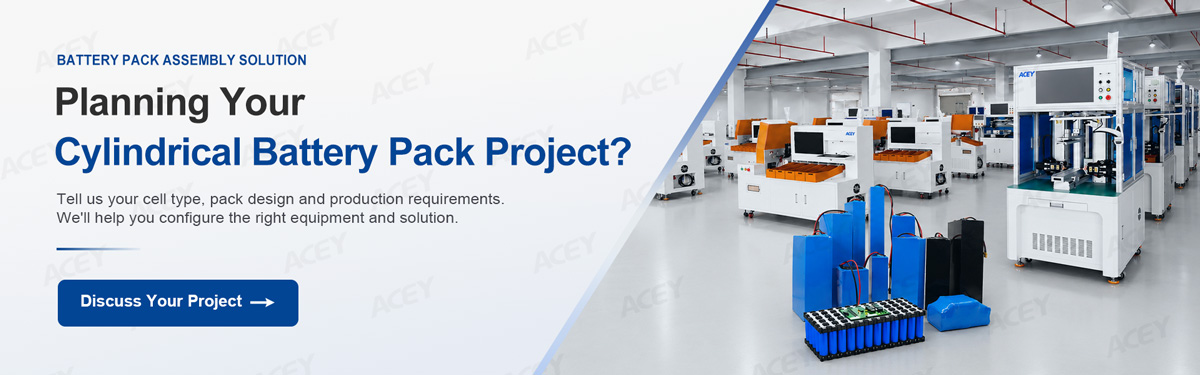
Please provide:
This information allows us to recommend the required machines, tooling, welding configuration and test system for the actual pack.
Discuss Your Battery Pack Assembly Project →
Frequently Asked Questions
*What machines are needed to make a cylindrical battery pack?
A typical production setup may include a cell grading machine, insulation paper sticking machine, OCV/IR sorter, CCD polarity tester, spot welder, BMS tester, battery comprehensive tester, packaging machine, coding machine and battery pack aging tester.
Small-batch production does not necessarily require all processes to be automated.
*What cylindrical cells can be used?
Common formats include 18650, 21700, 26650, 32650, 32700, 32140 and 33140.
Whether one machine can handle several cell sizes depends on its mechanical range and tooling. Fixtures, feeders and holders may need to be changed when switching cell formats.
What is the difference between capacity grading and OCV/IR sorting?
Capacity grading measures cell capacity through charge-discharge testing.
OCV/IR sorting measures open-circuit voltage and internal resistance and groups the cells according to preset ranges.
They are different steps and are often used together before battery pack assembly.
Why check cell polarity before welding?
A reversed cell can create the wrong series-parallel connection once the nickel strip is welded.
CCD inspection checks the complete cell arrangement before welding and identifies cells placed in the wrong direction.
What type of spot welder is used for cylindrical battery packs?
Resistance spot welding is commonly used for nickel and nickel-plated connecting strips.
ACEY provides 5000A, 8000A and 10000A welding power supply, including gantry, single-side automatic and double-side automatic configurations.
La macchina e i parametri di saldatura devono essere selezionati in base al terminale della cella, al materiale del nastro, allo spessore del nastro e al modello di saldatura.
Qual è la differenza tra la batteria?Pacchetto completo di test e test di invecchiamento?
È possibile che una singola linea di produzione realizzi diversi tipi di pacchi batteria?
Sì, ma non senza un cambio di gestione.
Se cambiano il diametro delle celle, le dimensioni del pacco o lo schema di saldatura, è necessario modificare anche il supporto, il dispositivo di fissaggio, l'alimentatore o il programma di saldatura.
Le linee semiautomatiche offrono maggiore flessibilità ai clienti che producono diversi modelli di pacchi batteria.
Di quali informazioni ha bisogno ACEY prima di consigliare una linea di produzione?
Le informazioni più utili sono:
Grazie a questi dettagli, è possibile selezionare le apparecchiature e gli strumenti più adatti in base al pacco batterie specifico, anziché utilizzare una configurazione di linea generica.
Rm703, No.223, Qishan North Road, Huli District, Xiamen, Fujian, China
E-mail : allen@xmacey.com
Tel : +8618950009155
Whatsapp : +8618950009155